Botly v2 is here: better quality suggestions, smarter replies, and a big upgrade overall.
Read what's newTinder Shadowban: How to Check If You Are Shadowbanned (2026)
Published on March 24, 2025
Read time 2 minutes
By Leo
A Tinder shadowban is when your account keeps working normally on the surface (you can still swipe, still open the app, still send messages) but Tinder quietly stops showing your profile to other people. Nobody tells you. The clearest single tell is a sudden, lasting drop to zero, or near zero, new matches paired with messages that go unanswered at a rate that is not normal for you. If yesterday you got a few matches a day and today the app has gone silent for a week or more with no change on your end, a shadowban is the most likely explanation.
One honest thing up front: Tinder has never officially confirmed that shadowbans exist, and there is no setting, page, or button anywhere that says “you are shadowbanned.” So everything below is pattern-reading, not a verdict from Tinder. We will be straight with you about what you can actually observe and what nobody can really know.
The Tinder shadowban test: a self-check you can actually do
Before anything else: there is no official Tinder shadowban checker, and any third-party “checker” tool that claims to scan your account is guessing. None of them can see Tinder’s backend. Tinder does not expose that data to anyone. So the real test is not a website. It is this checklist of things you can observe yourself. The more boxes you tick, the more likely it is that something is throttling your reach.
- Sudden match drop. Matches fell off a cliff and stayed there for a week or more, with no change to your photos, bio, or how much you swipe.
- Your likes do not seem to register. You swipe right on a lot of people and almost nothing comes back, even on profiles you would normally match with.
- Messages go unanswered at an abnormal rate. Not the usual half-ignored, but near total silence across many conversations, including matches who seemed keen.
- Your “Likes You” count is frozen. On Gold or Platinum, the number of people who liked you stops moving for days when it normally ticks up.
- Boost or Super Boost does almost nothing. You pay for a Boost and see little or no bump in matches, when a Boost normally produces a noticeable spike.
- No swipe surge. During busy hours (Sunday evenings, holidays) you feel none of the usual uptick everyone else reports.
- A second account behaves completely differently. If a friend nearby, or a fresh account on a different device and number, gets normal activity in the same area at the same time, that contrast is telling.
None of these on its own proves anything. One quiet week happens to everyone. But three or four of these together, lasting a couple of weeks, is the closest thing to a real shadowban test that exists. That combination, not any tool, is the signal.
[SCREENSHOT: Tinder match screen showing a flat, empty “It’s a match” area with no recent matches, illustrating the sudden match drop]
Shadowban vs. a normal ban: how to tell them apart
These get confused a lot. A normal ban is loud: you open Tinder and see error code 40303 or a message telling you your account has been banned for a Community Guidelines violation. You cannot get in. A shadowban is quiet: everything looks fine from your side, you just become invisible to other users. If you can still log in and swipe but nothing comes back, you are looking at a possible shadowban, not a full ban. If you are locked out entirely, that is a ban, and the path forward is different (appeal through Tinder support).
What causes a Tinder shadowban
Again, this is pattern-reading, not confirmed policy. But across years of user reports, the same triggers come up over and over:
- Reports from other users. The big one. A few people reporting your profile or messages, even unfairly, seems to be enough to quietly limit your reach.
- Resetting your account the wrong way. Deleting and remaking your account to get a “fresh start” is a common trigger, especially if you reuse the same phone number, photos, and device. Tinder appears to recognise the returning account and carry over its low standing.
- Payment and device fingerprints. The same card, phone, or Apple/Google account tied to a previously flagged profile can follow you onto a new one.
- Spammy or bot-like behavior. Copy-pasting the identical opener to everyone, sending links, or messaging at machine-like speed can look automated to Tinder’s systems.
- Right-swiping everything. Swiping right on nearly every profile makes you look less like a picky human and more like a bot, and it seems to hurt how often you get shown.
- Being brand new and very active. A day-one account that immediately swipes hundreds of times and fires off dozens of messages can trip the same wires.
What to do about it: an honest triage
No guide can promise to lift a shadowban, and anyone who guarantees an unban is selling you something. Here is the honest order to try things, from least to most drastic.
First, the low-effort fixes that sometimes work
- Just wait. Some reach throttling is temporary. Slow right down, swipe like a normal human (be selective), stop mass-messaging, and give it one to two weeks. A share of people recover on their own.
- Clean up what got you flagged. If you were mass right-swiping or copy-pasting the same opener, stop. Write short, specific first messages. Report and unmatch anyone who seems to be report-baiting you.
- Refresh your profile honestly. New, genuinely different photos and a rewritten bio can help you look like an active, real account again. This is not a magic fix, but it costs nothing.
- Contact Tinder support. A long shot for shadowbans since Tinder will not confirm one exists, but if you believe you were reported unfairly it is worth a polite message.
The full reset, done correctly
If the light fixes do nothing after a couple of weeks, the thing that most reliably works in user reports is a genuinely clean start. The reason casual resets fail is that people carry over the exact things Tinder uses to recognise the old account. A clean reset means changing as many of those as you realistically can:
- Delete the old account fully and give it a few days before remaking one.
- Use a new phone number for verification.
- Sign up with a fresh Apple or Google account, not the one linked to the old profile.
- Use a different payment method if you plan to subscribe again.
- Use fresh photos Tinder has not seen before, not the same set reuploaded.
- Do not carelessly reuse the same device fingerprint. Logging the new account into the same phone right after deleting the old one is the most common way a “fresh start” gets recognised and inherits the old limits.
Be realistic about the trade-offs. A clean reset means losing your existing matches and conversations, and any subscription time you had. It is not guaranteed. It is simply the approach with the best track record among people who report getting their reach back. If you travel or move, note that your matches also depend on location, and our guide on how to change your location on Tinder covers how that works.
How long does a Tinder shadowban last?
There is no official number because Tinder does not acknowledge shadowbans, so any exact figure you see is a guess. From user reports, lighter throttling can ease within one to two weeks if you change your behavior, while heavier cases often do not lift on their own at all, which is why a clean reset is the common route for those. Treat any “it lasts exactly X days” claim with suspicion.
Where our Chrome Extension fits in
One of the ways people accidentally trigger limits is by sending the same copy-pasted opener to everyone, which reads as automated. The Chrome Extension for Tinder helps you write short, specific first messages per match instead of mass-pasting the same line, which is exactly the behavior that looks bot-like. It cannot see Tinder’s backend and it cannot lift a shadowban (nothing can, on demand), so we will not pretend otherwise. It just helps you behave less like the thing that gets flagged.
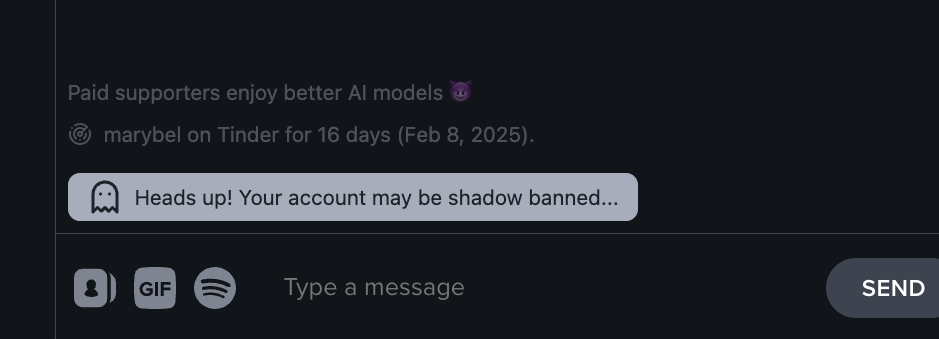
The extension can surface an advisory notice when your account matches shadowban patterns. It is advisory only: seeing it is not proof you are banned, and not seeing it is not proof you are safe.
FAQ
Is the Tinder shadowban real?
Tinder has never officially confirmed shadowbans, so strictly speaking it is unconfirmed. What is real is that huge numbers of users independently report the same pattern: a sudden, lasting collapse in matches with the app otherwise working normally. Whether you call that a “shadowban” or reach throttling, the observable effect is real enough to plan around.
Is there a real Tinder shadowban checker?
No. Tinder does not offer one, and no third-party tool can see your account’s real standing on Tinder’s servers. Any site calling itself a “shadowban checker” is inferring from the same signals you can check yourself. The self-check list above is the honest version of a checker.
Can you get shadowbanned on Tinder?
Based on years of consistent user reports, yes, accounts do appear to get quietly limited in reach. It commonly follows user reports, a badly done account reset, or behavior that looks automated (mass swiping, copy-pasted messages).
How is a shadowban different from being banned?
A ban locks you out with a clear message or error code (like 40303). A shadowban leaves you fully able to log in and swipe, but makes your profile invisible to others so nothing comes back. If you can still use the app but it has gone silent, it is a shadowban pattern, not a ban.
How do you fix a Tinder shadowban?
Start light: slow your swiping, stop copy-pasting openers, refresh your photos, and wait one to two weeks. If nothing changes, a clean reset (new number, fresh Apple or Google account, different payment method, new photos, and not reusing the same device carelessly) has the best track record. Nothing is guaranteed.
Does a Boost work if I am shadowbanned?
Usually not much, and that is itself a tell. Boost pushes your profile to the top of the stack, but if your reach is being throttled, being at the top of a queue almost nobody sees produces little. A Boost that does nothing is one of the signals in the self-check.
Want more Tinder how-tos? See our guide on how to see how long someone has been on Tinder. And if you want to go deeper on the community’s collected knowledge, the r/SwipeHelper wiki is a solid starting point: https://old.reddit.com/r/SwipeHelper/wiki/index.